

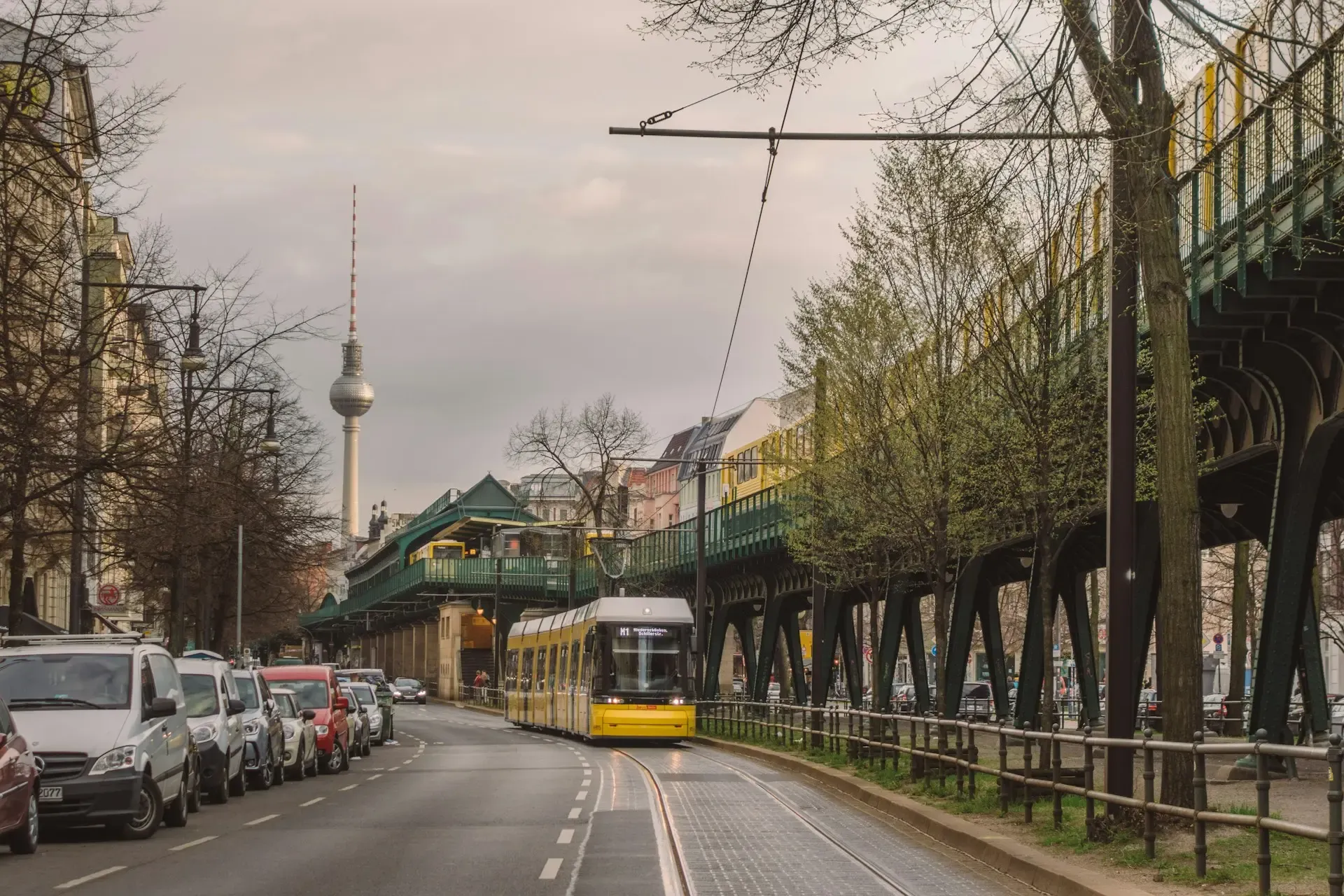
Berlin’s transport map looks intimidating at first, but you only need to understand three things to get started: most sightseeing within Berlin needs an AB ticket, the airport and Potsdam are in zone C, and the same local-transport ticket normally works on the U-Bahn, S-Bahn, trams and buses.
The trickier part is choosing between singles, 4-trip tickets, 24-hour tickets and tourist passes. I will show you what each actually covers, when the prices work in your favour, how to find the right platform and how not to get caught out by ticket validation. No transport expertise or German required.
Still choosing a hotel? Our where to stay in Berlin guide shows how to use stations and real journey times to avoid booking a room in the wrong part of the city.
Berlin public transport in 30 seconds
If you are staying around Mitte, Kreuzberg, Friedrichshain, Prenzlauer Berg, Schöneberg or Charlottenburg and visiting the usual city sights, buy an AB ticket. You do not need a special ticket for the Underground or a separate one for the bus. Your ticket covers the appropriate local services within its fare zones.
Arriving at Berlin Brandenburg Airport (BER)? Buy ABC for the journey into central Berlin. Visiting Potsdam? That also needs ABC from central Berlin. For the journey and what to do on arrival, see the Potsdam day trip guide. If you have a transport-only AB ticket, an extension ticket may be an option for a trip into C, but the ordinary extension does not work with a Berlin WelcomeCard.
For two ordinary AB trips, two €4 singles cost €8. For three, separate singles cost €12, making the €11.20 24-hour ticket slightly cheaper. But the €12.40 4-trip ticket works out at €3.10 per journey if you use all four portions, so the best choice depends on how many rides you will use during the whole stay, not merely this afternoon.
How Berlin’s transport system actually works
Berlin’s buses, U-Bahn and trams are run mainly by BVG. S-Bahn Berlin operates the suburban rail network, and regional services have other operators. For the traveller, the important part is that they sit within the VBB integrated fare system. An ordinary valid ticket covers the relevant local services in its zones, including eligible regional trains. An IC, EC or ICE long-distance train is a different product.
| Comparison | Best for | What to know |
|---|---|---|
| U-Bahn (U) | Neighbourhoods and short-to-medium city journeys | Often underground but not always. Follow the U-line number and the direction on the platform. |
| S-Bahn (S) | Longer cross-city rides, the Ringbahn and outer districts | Useful for crossing Berlin without changing repeatedly; some services extend beyond AB. |
| Tram / MetroTram | Eastern and north-eastern neighbourhoods | Particularly handy around Prenzlauer Berg and Friedrichshain; less extensive in the west. |
| Bus / MetroBus | Places without rail stations and short local connections | Normal BVG buses use VBB tickets; sightseeing buses do not. |
| RE / RB / FEX | Selected fast trips and airport connections | Regional/local services use VBB fares where applicable; check the exact service and zones. |
| BVG ferry | A few lake and river crossings | Scheduled public ferries are different from paid sightseeing cruises. |
For a first visit, the U-Bahn and S-Bahn will probably do most of the work. Add trams and buses when the journey planner recommends them rather than trying to force every journey onto a train.
You can also use the city’s normal transport network for some sightseeing. The U5 connects Hauptbahnhof, Bundestag, Brandenburger Tor, Unter den Linden, Museumsinsel and Alexanderplatz. It is a wonderfully convenient first-day corridor, although the stations themselves are only one part of what is worth seeing. For a walking-first introduction, see our first-time Berlin guide.
Berlin transport zones explained: A, B and C
The zones are simpler than the map suggests:
- A is central Berlin, up to and including the S-Bahn Ring.
- B is the rest of Berlin between the Ring and the city boundary.
- C covers the surrounding area, including BER Airport and Potsdam.
Tickets are usually sold for AB, BC or ABC, not individual A or B zones. The Ringbahn is useful as a mental boundary, but it is not the edge of Berlin. Plenty of normal Berlin neighbourhoods lie in zone B.
| Comparison | What it covers | When to choose it |
|---|---|---|
| AB | Central and outer Berlin within city limits | Sightseeing across Berlin, hotels within the city, usual attractions and nightlife. |
| ABC | Berlin plus surrounding zone C | From central Berlin to BER Airport, Potsdam or other zone-C destinations. |
| BC | Zones B and C without central A | Less common for tourists. Useful only when neither end of your trip enters A. |
Alexanderplatz, the Brandenburg Gate, Museum Island and Zoologischer Garten are all in zone A. Much of outer Charlottenburg and other districts lie in B. Both A and B are covered by the same AB ticket.
Do you need AB or ABC?
Choose AB unless you know your trip enters C. The clearest common exceptions are BER Airport and Potsdam. You do not need to buy ABC for every day of a Berlin holiday just because your flight lands at BER: you can use an ABC ticket for arrival and departure and AB tickets while staying inside the city.
Always check the actual route. An outer station or a day trip outside the city can change the answer.
Berlin public transport ticket prices in 2026
The €4 single ticket: 120 minutes, but not a round trip
A standard AB single ticket lets you travel towards your destination and change lines as needed for up to 120 minutes. You may interrupt the journey, but you cannot use the ticket to go back towards your starting point or make a round trip just because the two hours have not run out.
Imagine travelling from your hotel to a museum, visiting it for twenty minutes and taking the same train back. That return journey normally needs a new ticket, even if the original 120-minute window has not expired. It is a time limit on a valid journey, not two hours of unlimited travel.
The short-trip ticket: useful, but easy to misuse
For €2.80, Berlin’s short-trip ticket covers up to three S-Bahn or U-Bahn stations, with changes allowed but without an interruption, or up to six stops on a bus or tram under its short-trip conditions. It is not simply a €2.80 ticket for any twenty-minute trip. Mobile short-trip tickets have their own time rule; check the active ticket in the app.
A concrete example: on the U5, Brandenburger Tor → Museumsinsel is two stops, so it can fit the rail short-trip rule. Brandenburger Tor → Alexanderplatz is four stops (via Unter den Linden, Museumsinsel and Rotes Rathaus), so that route does not fit a three-station short-trip ticket. One extra stop makes a difference.
Four rides for less: the 4-trip ticket
The AB 4-trip ticket costs €12.40 instead of €16 for four separate singles. That is a saving of €3.60 across four journeys. You must activate or validate a new portion for each journey. Do not assume one validated portion permits four rides.
It is particularly useful when you know you will make a handful of one-way trips across several days and do not need unlimited daily travel. Only compare the €3.10 effective price with other tickets when you will actually use all four portions.
Unlimited rides: the 24-hour ticket
The AB 24-hour ticket is €11.20. It lasts 24 hours from validation, not until midnight, and permits unlimited journeys in the selected zones during that period.
Three separately purchased AB singles cost €12, so a 24-hour AB ticket saves €0.80 in that case. Four singles cost €16, a larger difference. However, four portions of an AB 4-trip ticket cost only €12.40 in total, so always think about both the number of rides and whether you will use a 4-trip ticket across your stay.
A separate benefit matters for families: BVG says a standard adult 24-hour ticket can take up to three children aged 6 to 14 for free. Children under six travel free anyway.
Small-group tickets: the break-even calculation
The 24-hour small-group ticket is for up to five people travelling together, not five independent tickets that can be split among different itineraries.
| Comparison | Separate adult 24-hour tickets | Small-group 24-hour ticket | Cheaper option |
|---|---|---|---|
| 2 adults, AB | €22.40 | €35.30 | Separate tickets |
| 3 adults, AB | €33.60 | €35.30 | Separate tickets |
| 4 adults, AB | €44.80 | €35.30 | Group, saves €9.50 |
| 5 adults, AB | €56.00 | €35.30 | Group, saves €20.70 |
| 3 adults, ABC | €38.70 | €37.70 | Group, saves €1.00 |
| 4 adults, ABC | €51.60 | €37.70 | Group, saves €13.90 |
| 5 adults, ABC | €64.50 | €37.70 | Group, saves €26.80 |
The rule of thumb: the group day ticket becomes cheaper than individual adult 24-hour tickets from four people in AB, but already from three people in ABC. If you only plan one or two rides, compare single tickets too.
Extension tickets and the AB-to-C trap
An eligible ordinary AB ticket can be combined with an extension for a trip into C. The single extension currently costs €2.40 and has its own conditions. This can help a traveller who already holds a qualifying AB ticket, but buying a full ABC fare may be simpler when starting fresh.
Do not use this shortcut with a Berlin WelcomeCard. BVG explicitly says normal extension tickets are not valid for tourist tickets. Choose the WelcomeCard zone you actually need at purchase.
What about a 7-day ticket?
Some older guides still recommend a Berlin 7-day ticket. VBB discontinued 7-day tickets from 1 January 2026. Do not build a 2026 itinerary around one. For longer stays, compare current multi-day tourist products, monthly options and the Deutschlandticket.
Is the Deutschlandticket useful for tourists?
The Deutschlandticket costs €63 per calendar month in 2026 and is a subscription, not a normal three-day visitor pass. It covers local public transport and second-class regional rail across Germany, but not the usual IC, EC or ICE long-distance services. It is personal and does not normally let you take additional people or bicycles for free.
It may be worthwhile when your Berlin trip is part of a longer journey around Germany or you are staying for several weeks. Check subscription activation and cancellation conditions before buying; for a short city break, ordinary tickets are usually less complicated.
Which ticket should you actually buy?
| Comparison | Likely best starting point | Check before paying |
|---|---|---|
| One or two rides today | Single tickets, or portions of a 4-trip ticket | Do you already have unused portions? |
| Three-plus rides in 24 hours | Compare the 24-hour ticket | Could a 4-trip ticket used throughout the visit cost less overall? |
| Travelling with children | Adult 24-hour ticket or a suitable tourist card | Check the current free child carry-along conditions. |
| Four or five adults together | 24-hour small-group ticket | You must travel together; compare singles for very light use. |
| BER Airport to central Berlin | ABC single or another valid ABC product | AB does not cover the airport. |
| Paid attractions on several days | Compare the Berlin WelcomeCard | Will you really claim enough discounts to justify its extra cost? |
| A month around Germany | Evaluate Deutschlandticket | It is a personal subscription with cancellation rules. |
If you need help grouping sights into realistic days, our Berlin one-day itinerary, two-day route and three-day itinerary show where you can walk and where a train genuinely saves time.
Is the Berlin WelcomeCard worth it?
The official Berlin WelcomeCard Classic combines local transport with advertised discounts at 170+ attractions and partners, with savings of up to 50% at participating places. It comes in AB and ABC versions, and the standard options run from 48 hours to six days. That makes it worth understanding, but not automatically worth buying.
The correct comparison is:
WelcomeCard price − ordinary transport you would actually buy = the discounts you need to recover.
For example, a 48-hour AB WelcomeCard costs €28.50. Two separate adult AB 24-hour tickets cost €22.40. The WelcomeCard costs €6.10 more, so it can be better value if you will genuinely save more than €6.10 at participating attractions you already want to visit. A 72-hour AB card costs €39.50; three ordinary AB 24-hour tickets cost €33.60, a €5.90 difference. Those are illustrative comparisons, not proof that someone who walks most of the day needs either product.
| Comparison | WelcomeCard AB | WelcomeCard ABC |
|---|---|---|
| 48 hours | €28.50 | €34.50 |
| 72 hours | €39.50 | €45.50 |
| 4 days | €49.50 | €56.50 |
| 5 days | €53.50 | €59.50 |
| 6 days | €58.50 | €63.50 |
Select ABC if the card must include journeys to BER Airport or Potsdam. Do not purchase AB expecting to add a standard extension later. If you are mostly visiting free museums, monuments, memorials and neighbourhoods, ordinary transport tickets may be a better fit.
Also distinguish discounts from included admission. Classic WelcomeCard does not mean every museum or attraction is free. Museum Island and All Inclusive are separate, higher-priced variants with their own terms. And because offers and admission prices can change, check the actual partners you intend to use.
To compare Classic with the Museum Pass and the Museum Island variant across six real trips, read our Berlin WelcomeCard vs Museum Pass guide.
The following two registered products let you compare a Berlin WelcomeCard with EasyCityPass if you prefer a transport-and-discounts product. These are commercial tourist products, not the only way to buy ordinary BVG transport.
How to buy a Berlin ticket
For most visitors, the simplest approach is to use a BVG app or a machine at a station. Machines and local sales outlets remain useful if your phone is low on battery.
- BVG Fahrinfo: the strongest all-round choice for planning an actual journey and buying a ticket. It shows lines, connections, stops and disruptions.
- BVG Ticket: a focused app if you mostly need ticket purchase.
- BVG Jelbi: combines public-transport journey planning and tickets with access to various shared mobility providers.
- Ticket machines and counters: available at many U-Bahn/S-Bahn stations and transport sales outlets.
- On the bus: BVG drivers sell selected tickets cashlessly, including with supported bank cards or mobile payments. Tickets bought from the driver are normally already validated.
- On the tram: machines may be available on board. Check whether your ticket is already validated.
Download an app and arrange payment before you urgently need a ticket. BVG states that ticket purchases through its apps can use common digital payment methods; the exact options depend on the app and account setup.
How to validate your ticket without getting fined
This is the rule visitors need most: owning a ticket is not necessarily the same as holding a valid ticket.
With an ordinary paper ticket that needs validation, look for the small validator. On U-Bahn and S-Bahn journeys, it is at the station or platform, before boarding, not on the train. On buses, trams and ferries, validation equipment may be on board. If you have purchased a ticket on a bus or tram and it already shows a valid time, do not stamp it again just because you see a validator.
With a mobile ticket, activate it in the app before you start your journey and check that it shows as valid. Don’t wait until you see inspectors. The exact behaviour of different products can vary, especially subscriptions and timed tourist cards.
There are generally no turnstiles at Berlin U-Bahn or S-Bahn station entrances. Inspections happen within the network. BVG lists an increased transport charge of €60 for travelling without a valid ticket, including a ticket that needed validation but was never stamped.
How to read the Berlin transport map
First, use the official diagram to understand where the lines run and where they cross. Then use a live journey planner to choose the actual train for your trip.
A station marked U is on the U-Bahn network; S marks S-Bahn. A station labelled S+U serves both. Line names such as U5 or S9 are not platform numbers. You will also see coloured line traces and interchange stations where two or more lines meet.
Most importantly, trains show the direction using a line destination. The line number alone is not enough: U5 runs in both directions, for example, towards Hönow or Hauptbahnhof. At the platform, check the destination display against the direction suggested by your journey planner.
Example: Brandenburg Gate to Alexanderplatz
Take the U5 towards Hönow from Brandenburger Tor and get off at Alexanderplatz. The stops in between are Unter den Linden, Museumsinsel and Rotes Rathaus. This is a useful first-trip example because it needs no change, and it also shows why a short-trip ticket will not do: Alexanderplatz is four stations from Brandenburger Tor.
If your destination is Museumsinsel, that is just two U5 stops from Brandenburger Tor and may qualify for a rail short-trip ticket if you follow the short-trip conditions.
Example: Alexanderplatz to East Side Gallery
Look for an eastbound S-Bahn service calling at Ostbahnhof, then walk towards the East Side Gallery from there. The journey planner will tell you which S line and platform currently serve the route. This is much better than choosing a line based only on its colour on a static diagram.
A simple six-step method
- Search your exact destination or hotel address, not just the district.
- Find the nearest station and recommended line.
- Check whether the trip stays in AB or enters C.
- At the station, follow the line number to the correct platform.
- Confirm the train’s displayed direction and stopping pattern.
- Validate or activate the appropriate ticket before riding.
Official map to open or save: BVG Berlin ABC S-Bahn, U-Bahn and regional-rail network PDF. It includes fare-zone boundaries and is the best companion to this explanation.
You can also find the AB-only, bus-and-ferry, tram and night-network PDFs on BVG’s official network maps page. These are external official maps; they are not reproduced as local image assets here. Use a live planner for disruptions, elevator failures or changed services.
How the Ringbahn works: S41 and S42
The Ringbahn forms a loop around inner Berlin. S41 runs clockwise; S42 runs counter-clockwise. The loop is about 37 km, with a typical daytime circuit taking around 59 minutes, according to S-Bahn Berlin.
You do not have to ride the full Ring. If you’re moving between two stations on the loop, one direction may be much shorter. The useful question is not “Which train is the Ringbahn?” but “Do I need S41 or S42 from this station?” Your journey planner will tell you.
Getting from BER Airport to Berlin
BER Airport is in zone C. Travelling to central Berlin requires a Berlin ABC ticket. The airport railway station, Flughafen BER, is directly under Terminal 1 on level U2. From Terminal 2, follow the airport signs towards Terminal 1 and its train station.
The right connection depends on your accommodation:
- FEX (Airport Express): the direct fast corridor via Südkreuz, Potsdamer Platz and Hauptbahnhof. The airport publishes approximately 14 minutes to Südkreuz, 19 to Potsdamer Platz and 23 to Hauptbahnhof.
- S9: useful for stations along its east-west city route, including places such as Alexanderplatz and Zoologischer Garten, depending on the precise destination.
- S85: an option for destinations on the eastern and north-eastern network.
- Other regional services and buses: useful for particular neighbourhoods, but not necessarily better for the city centre.
As of October 2026, the airport lists the FEX, regional services and S9/S85. Do not rely on old articles telling you to take the S45 to BER. That service was discontinued in the December 2025 timetable change.
At the airport, buy ABC at the machine or in the app before boarding, unless you already have an appropriate valid ticket. A Berlin WelcomeCard ABC can also cover your transport if its validity conditions are satisfied. An AB WelcomeCard is not enough for the airport, and you cannot top it up with the ordinary zone-C extension.
Construction and airport rail timetables can change. The official BER public transport page and the VBB journey planner should be your final check on travel day, not a timetable copied into a static travel article.
Getting around Berlin at night
Berlin has late-night transport, but not every daytime line runs continuously every night. On weekend nights, many U-Bahn and S-Bahn routes have overnight service, sometimes at a lower frequency. On regular weeknights, night buses replace parts of the U-Bahn network, including N1 to N9 corridors.
Check the actual last connection in your journey planner. A train that runs at 00:30 tonight may not run at the same time tomorrow, particularly after an event or during engineering works. At night, a direct bus may be easier than several train changes even when the app estimates a slightly longer journey.
The BVG night-network map is useful for orientation, while live routing is better for the actual departure.
Berlin public transport with children and groups
BVG’s ordinary fare rules let children under six travel free. Children aged 6 to 14 generally use reduced tickets when travelling on their own fare. But the adult 24-hour ticket can bring up to three children aged 6 to 14 at no additional fare. The standard WelcomeCard includes a similar family take-along benefit, subject to the actual product conditions.
This means the best ticket for a family can be quite different from the best ticket for two adults. Check the adult ticket’s child allowance before purchasing separate child day tickets.
For strollers, choose the simplest route rather than the fastest-looking route with three transfers. Lift outages can make a journey dramatically longer. Our Berlin with kids guide includes attractions that fit better into relaxed family days.
For groups, remember that a small-group 24-hour ticket is shared. Everyone using that ticket must stay together during travel. If your group separates after lunch, individual products may be safer even if they cost slightly more.
Bicycles, dogs, luggage and strollers
Bicycles are not automatically covered by a passenger ticket. Standard bicycles normally need an additional bicycle ticket for the correct zones. BVG allows them in designated areas on U-Bahn, S-Bahn, trams and relevant ferries when space allows. They are generally not permitted on normal buses; limited night-bus exceptions apply on N1–N9 when there is space. A fully folded folding bike is treated as hand luggage.
Bicycle space is never guaranteed, and wheelchairs and strollers take priority. If a carriage is crowded, you may need to wait for another service.
For dogs, the rule depends on the passenger ticket: on an ordinary single ticket, a dog generally requires the relevant reduced fare, while one dog can be taken along free with certain 24-hour products. Check the exact conditions for more than one dog.
Ordinary hand luggage, strollers and wheelchairs can be taken without buying an additional normal passenger ticket, subject to the operator’s carriage rules. Avoid blocking doors, wheelchair spaces or emergency exits.
Should you use a hop-on hop-off bus instead?
A hop-on hop-off sightseeing bus is a tourist experience with its own ticket, not part of the BVG/VBB transport system. A standard AB ticket will not let you board it. Think of it as a way to get commentary and an overview of famous places, not as the most efficient way to reach an ordinary hotel or restaurant.
It can be genuinely useful if this is your first morning, you want an easy overview, have limited energy for walking or prefer not to navigate several transfers. The tradeoffs are cost, fixed sightseeing loops, traffic and stops that may not match your plans. For direct journeys, especially outside the classic sightseeing centre, normal public transport is usually the better tool. To choose between operators, see our Berlin hop-on hop-off bus comparison.
For a comparison, these are two of the registered sightseeing-bus products available through GetYourGuide. Check each product’s current route, included days and departure points before booking.
When getting around is the experience: a Trabi Safari
The Trabant belongs to a different category entirely. A Trabi Safari is not a way to commute around Berlin: it is a paid sightseeing activity in which the drive itself is part of the attraction.
The distinctive East German car offers a very different perspective on the city’s streets, and a guided convoy can be a memorable way to see familiar places. But it is not a substitute for the U-Bahn if you’re trying to reach dinner on time. Treat it as an optional experience for people who genuinely enjoy unusual vehicles or the city’s twentieth-century history.
The registered GetYourGuide experience below is the Berlin Trabi Safari the user selected. Confirm the precise duration, driver requirements, meeting point and booking conditions on the live product page.
Twelve Berlin transport mistakes worth avoiding
- Buying AB for an airport ride into central Berlin. BER is in C; you need ABC for that journey.
- Using one single ticket to return within 120 minutes. Single tickets are directional, not a two-hour unlimited pass.
- Forgetting to stamp a paper ticket. Ticket ownership is not ticket validity.
- Waiting to activate a digital ticket. Do it before travel begins.
- Assuming open platforms mean no ticket is needed. Inspections are part of a proof-of-payment system.
- Choosing ABC for an entire stay that never leaves Berlin. AB usually covers ordinary city sightseeing.
- Buying a WelcomeCard without checking discounts. A card is only valuable when it matches your real plans.
- Following old advice about a 7-day ticket. That ticket was discontinued in January 2026.
- Ignoring the train destination sign. The correct line in the wrong direction is still the wrong train.
- Expecting the static network map to reflect a lift outage. Use live route information.
- Treating a hop-on hop-off bus as a BVG bus. Tourist sightseeing tickets and ordinary transport tickets are different.
- Bringing a normal bicycle without checking its ticket and permitted vehicle. Space and carriage rules apply.
The simplest plan for your first 24 hours
On arrival, work out whether your airport journey needs ABC. Get to your accommodation using the actual hotel address, not a guess based on the district. For the next morning, open the network map, pick two or three sights in one part of town and decide how many genuine journeys you are likely to make.
If you are exploring central Mitte, you’ll often discover that walking connects more places than you expected. If you’re heading from the centre to the Berlin Wall Memorial, the East Side Gallery or another neighbourhood, the train earns its place. The best Berlin ticket is not the most comprehensive one: it is the cheapest valid option that fits how you will actually spend your day.
For your next step, browse our Things to Do in Berlin guide or the four-day itinerary to turn the transport advice into a realistic trip.
Frequently asked questions
Is Berlin public transport easy for tourists?
Yes. Most visitors can use one integrated VBB ticket for the U-Bahn, S-Bahn, trams and buses within the zones purchased. Start by checking whether your journey needs AB or ABC.
Do I need an AB or ABC ticket in Berlin?
AB is usually enough for journeys within Berlin. Use ABC for journeys from central Berlin to BER Airport, Potsdam or other zone-C destinations.
Is BER Airport in zone C?
Yes. Berlin Brandenburg Airport is in zone C, so a journey from central Berlin in zone A requires an ABC ticket.
Can I use the same ticket on the U-Bahn, S-Bahn and bus?
Yes. Valid VBB local tickets generally work across U-Bahn, S-Bahn, buses, trams and eligible regional trains within the ticket's zones and validity conditions.
Do Berlin tickets need validation?
Paper tickets that require validation must be stamped before travel, and mobile tickets must be activated according to the app's instructions. Tickets that are already valid should not be stamped again.
Are there ticket barriers in Berlin?
Generally no. Berlin's U-Bahn and S-Bahn stations use a proof-of-payment system. Ticket inspections take place even though stations usually have open entrances.
Can I return on a Berlin single ticket within two hours?
No. The regular single ticket is valid for up to 120 minutes for a journey in one direction. Return and round trips are not permitted.
Is there still a seven-day Berlin transport ticket?
No. VBB discontinued the seven-day ticket from 1 January 2026. Older websites may still recommend it.
Is the Berlin WelcomeCard worth buying?
Only when its transport coverage and the attraction discounts you will actually use justify the price. Compare it with the ordinary tickets you would otherwise buy.
Do children travel free on Berlin public transport?
Children under six travel free. Children aged 6 to 14 usually pay a reduced fare, but a qualifying adult 24-hour ticket can carry up to three children in that age range free.
Does Berlin public transport run all night?
Many lines run overnight on weekend nights, while night buses cover important routes on regular weeknights. Check BVG or VBB for the exact line and departure date.
What is the fine for travelling without a valid ticket?
BVG charges an increased transport fare of €60 when a passenger travels without a valid ticket, which can include an unvalidated ticket that requires stamping.
Sources
- BVG: Tickets and current fares (opens in a new tab)2026 prices and fare products.
- BVG: Tariff zones (opens in a new tab)Where zones A, B and C apply.
- BVG: Tickets for tourists and validation (opens in a new tab)Validation, travel rules and ticket purchase.
- BVG: Official network maps (opens in a new tab)Current downloadable network PDFs.
- VBB: January 2026 ticket changes (opens in a new tab)Includes discontinuation of the 7-day ticket.
- VBB: Announced January 2027 fares (opens in a new tab)Future fare changes announced in September 2026.
- BER Airport: Public-transport connections (opens in a new tab)Current train services, station location and airport connections.
- S-Bahn Berlin: Timetables by line (opens in a new tab)S41 and S42 Ringbahn direction and operating patterns.
- BVG: Berlin WelcomeCard 72 hours (opens in a new tab)Validity, inclusions and zone-extension restriction.
- Berlin WelcomeCard: Official prices and variants (opens in a new tab)Current Classic card options and prices.
- BVG: Bicycle transport (opens in a new tab)Ticket, space and carriage restrictions.
- BVG: Ticket inspections (opens in a new tab)Increased transport charge for travelling without a valid ticket.
Related guides



This article contains affiliate links. If you book through them, we may earn a commission at no extra cost to you.Affiliate disclosure